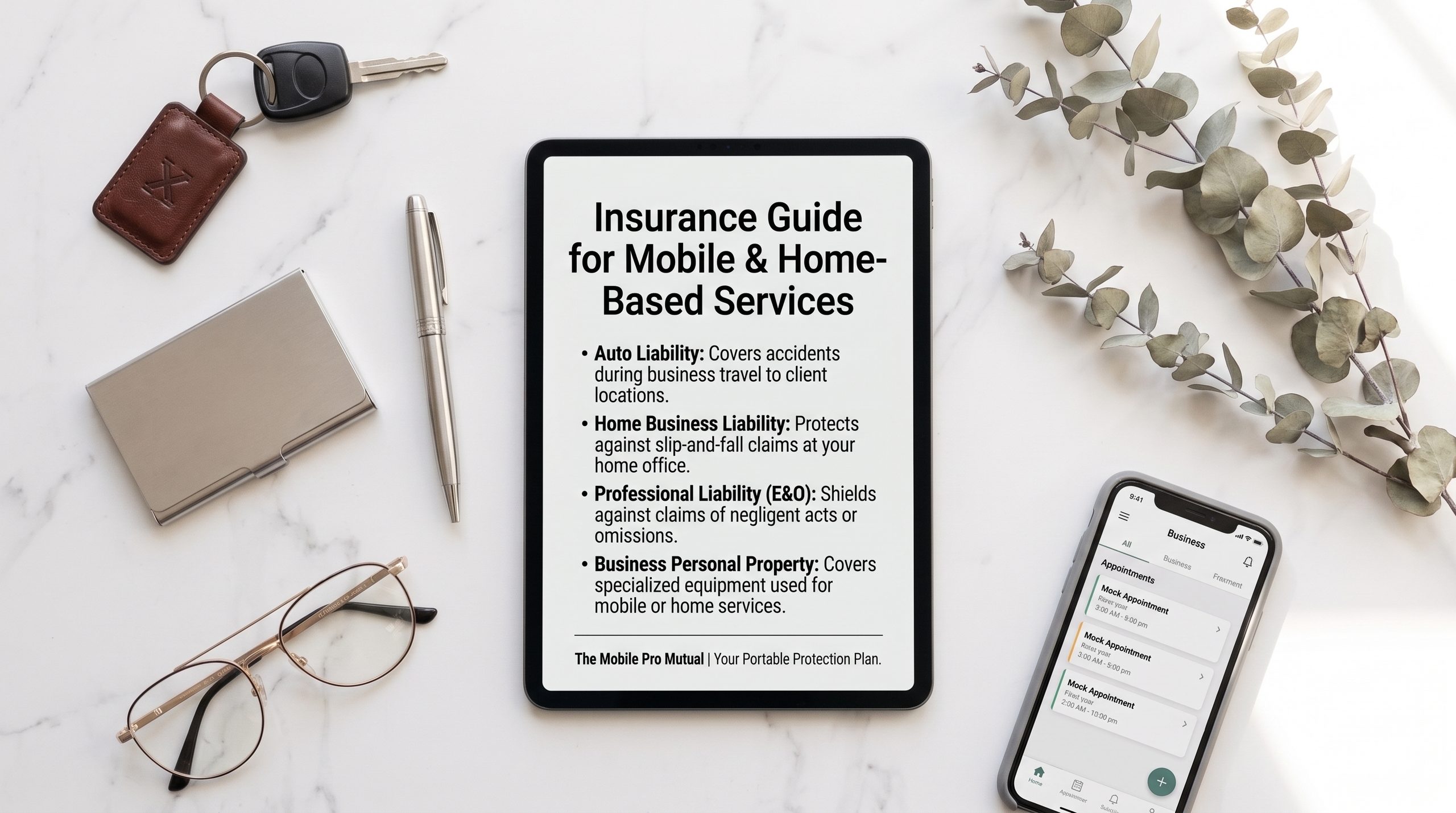
Not every business has a storefront, and for a lot of wedding and creative vendors — florists working from a home studio, mobile hair and makeup artists, photographers who edit from a spare room — that’s exactly the point. But operating without a fixed commercial location doesn’t mean you’re operating without risk. In some ways, mobile and home-based businesses face a more scattered set of exposures, simply because the work happens in more places: a client’s home, a rented van, a wedding venue, and a home office, sometimes all in the same day.
Why “No Storefront” Doesn’t Mean “No Risk”
It’s a common and costly assumption: if there’s no physical shop for the public to walk into, there’s less to insure. In practice, mobile and home-based businesses carry risk across several separate fronts that a traditional storefront business might have consolidated under one roof:
- On the road, transporting equipment, product, or clients
- At the client’s location, working in someone else’s home or a rented venue
- At home, storing inventory, tools, or client information
- Online, if bookings, payments, or client communication happen digitally
Each of these has its own insurance implications, and a policy built for a fixed-location business often doesn’t automatically extend to cover all of them.
General/Public Liability: Still the Foundation
Whether you work from a home studio or a rented chair in someone else’s salon, general liability (called public liability in the UK) remains the core policy. It covers third-party injury or property damage connected to your work — a client tripping over your equipment in their own living room, or a piece of gear damaging a rented venue’s flooring. Most venues and many clients now expect to see proof of this coverage before booking, even for mobile services.
Why Homeowners’ Insurance Usually Isn’t Enough
This is one of the most common and expensive misunderstandings among home-based business owners: a standard homeowners’ or renters’ insurance policy is built around personal, non-business use of the home. Most of these policies explicitly exclude business-related claims — meaning if a client is injured during an at-home consultation, or business inventory is damaged in a fire, a standard homeowners’ claim could be denied outright.
Two ways to close this gap:
- A home-based business endorsement/rider, added to an existing homeowners’ policy, which extends limited coverage to business equipment and liability
- A separate business owner’s policy (BOP), which bundles general liability with property coverage for inventory, tools, and equipment — often the better option once a home-based business grows beyond very small
Commercial Auto Coverage: The Other Common Gap
If your business involves regularly driving to clients’ homes or venues — delivering flowers, transporting hair and makeup kits, hauling photography or DJ equipment — a personal auto insurance policy may not cover accidents that happen while driving for business purposes. Insurers can and do deny claims when they determine a vehicle was being used commercially at the time of an incident.
Depending on how often and how extensively you use a vehicle for work, the right fix is either:
- A commercial auto policy, if the vehicle is used primarily for business
- A business-use endorsement added to a personal auto policy, for lighter or occasional business use
- Hired and non-owned auto coverage, if employees or contractors sometimes use their own cars for your business
Equipment and Inventory Coverage While On the Move
Mobile businesses often carry meaningful value in transit — a florist’s stock in a van, a mobile stylist’s kit, a DJ’s sound equipment. Standard property insurance tied to a fixed location typically doesn’t cover items while they’re being transported or used off-site. Inland marine insurance (despite the name, it has nothing to do with boats) is designed specifically to cover business property while it’s in transit or being used at multiple locations — a common and often overlooked gap for mobile vendors.
Professional Liability: Covering the Work Itself
Separate from physical injury or property damage, professional liability (errors and omissions) coverage protects against claims that your service didn’t meet what was promised — a missed appointment, work that didn’t match the agreed design, or a documented financial loss tied to your service falling short. This matters just as much for mobile and home-based businesses as it does for those with a storefront, since the nature of the claim isn’t about location.
Data and Client Information
Even a small home-based business often stores client names, addresses, contact details, and sometimes payment information — through a booking app, spreadsheet, or CRM. A data breach or lost device can create liability exposure that general liability doesn’t cover. Cyber liability insurance, while often overlooked by small home-based operations, is increasingly worth considering as more booking and payment happens digitally.
Building the Right Coverage Stack
For most mobile or home-based wedding and creative vendors, a reasonably complete insurance picture looks like:
- General/public liability — the non-negotiable baseline
- Home-based business endorsement or a BOP — to close the homeowners’-insurance gap
- Commercial auto coverage or a business-use rider — if driving is a regular part of the job
- Inland marine/equipment coverage — for tools and inventory in transit
- Professional liability — for claims about the work itself, not just physical injury
- Cyber liability — worth a look once digital bookings and client data are part of daily operations
Questions to Ask Before Buying
- Does my current homeowners’/renters’ policy explicitly exclude business use, and does my insurer offer a rider to close that gap?
- Is my vehicle covered for business use, or only personal use, under my current auto policy?
- Does my equipment coverage apply while in transit and at client locations, not just at home?
- Do I store any client data digitally, and if so, is that a specific coverage type my current policy doesn’t address?
Final Thoughts
Mobile and home-based service businesses often assume their risk is lower simply because there’s no storefront — in reality, the risk is just spread across more locations: the road, the client’s space, and the home itself. Closing the gaps that standard homeowners’ and personal auto policies leave behind is usually the single most overlooked (and most costly, if skipped) step for vendors working this way.
This article is for general informational purposes only and does not constitute insurance, legal, or financial advice. Insurance coverage, requirements, and costs vary by state, country, insurer, and individual business circumstances. Always confirm your specific coverage needs directly with a licensed insurance agent or broker before making a purchasing decision.
Leave a Reply