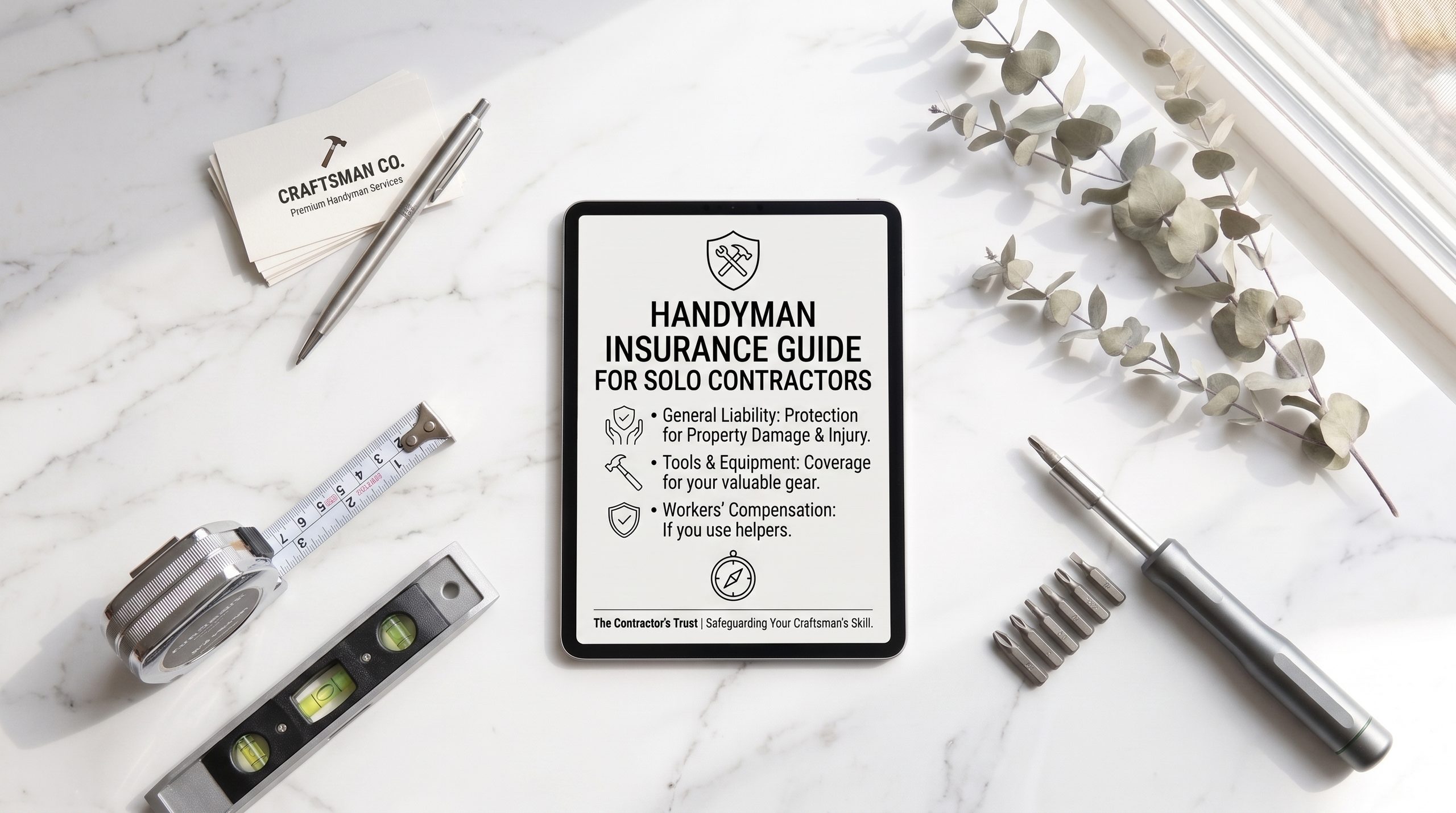
Working alone doesn’t shrink the risk of a handyman business the way it might seem to — a solo operator still walks into other people’s homes with tools, drives to every job, and can cause the same kind of damage a larger crew could. The honest answer to “do I need insurance as a solo handyman” is almost always yes, even where the law doesn’t technically require it.
The Legal Answer vs. the Practical Answer
Most states don’t legally mandate general liability insurance for small handyman jobs. A handful of states — California, Arizona, Nevada, Oregon, and Alaska among them — require insurance or bonding once your job value crosses a certain dollar threshold, or if the scope of work pushes you into contractor licensing territory. Outside those specific triggers, there’s often no blanket legal requirement.
But the practical requirement is close to universal. Property management companies, apartment complexes, and HOAs routinely won’t let you on their properties without a certificate of insurance, often specifically requiring $1 million in liability coverage as a condition of even bidding on the work. Homeowners, especially in higher-value neighborhoods, increasingly ask for proof of insurance before hiring, treating it as a basic professionalism signal rather than an unusual request. In practice, going without coverage doesn’t just leave you personally exposed — it locks you out of a meaningful share of the work available.
What Happens Without Coverage
If a client trips over your tools, or you damage hardwood flooring, a wall, or an appliance while working, you’re personally liable for the full cost without insurance in place — there’s no employer or larger company to absorb it. For a solo operator, that liability lands entirely on personal assets and income, which is exactly the exposure general liability insurance is built to prevent.
The Core Coverage: General Liability
General liability insurance is the essential starting point, covering:
- Property damage — accidentally damaging a wall, floor, appliance, or fixture while working
- Bodily injury — a client or bystander injured in connection with your work, such as tripping over equipment
- Legal defence costs if a claim escalates into a lawsuit
Typical policies for a self-employed handyman carry liability limits between $300,000 and $1 million per claim, and pricing commonly runs a modest daily-equivalent cost — often cited as roughly $1–$2 per day once annualized — which is frequently far less than the cost of losing a single property management contract over a missing certificate of insurance.
Tools and Equipment Coverage
This is a gap worth understanding clearly: general liability does not cover your own tools. If your equipment is stolen from your truck, damaged on a job site, or lost in transit, a separate policy — often called tools and equipment coverage, or inland marine insurance — is what actually protects it. For most handymen, tools represent one of the largest single investments in the business, making this add-on worth pricing out rather than assuming it’s bundled by default.
Commercial Auto Insurance
If you drive a vehicle to jobs — which describes essentially every handyman business — a personal auto policy generally excludes accidents that happen while conducting business. Commercial auto insurance covers accidents, repairs, and liability connected specifically to business-related driving, and is a near-universal requirement once a vehicle is part of daily operations.
Workers’ Compensation
Not typically relevant for a true solo operator with no employees, but this becomes a requirement the moment you bring on any paid help — even occasional or part-time. It’s worth planning for even before you actually hire, since the requirement triggers immediately rather than after some grace period.
Bonds: A Different Kind of Protection
A handyman bond isn’t insurance — it’s a financial guarantee to your client that if you fail to complete a job or cause a dishonest loss, the bonding company compensates the client, then seeks reimbursement from you. Bonds are often inexpensive relative to their value as a trust signal, and can meaningfully help when competing for higher-value residential or property management accounts where clients specifically look for “licensed, bonded, and insured” contractors.
The Exclusion That Catches Handymen Off Guard
If you perform licensed-trade work — plumbing, electrical, HVAC — that legally requires a specialized license, and a claim arises from that specific work, your general liability carrier may deny the claim on the grounds that the work was performed outside your licensed scope. This is one of the most common and most preventable coverage gaps in the industry: know exactly where your work crosses from general handyman tasks into licensed-trade territory, and confirm your policy’s stance on that boundary before it becomes a claim.
What to Confirm Before You Start Taking Jobs
- Does your state or local jurisdiction require licensing or bonding above a certain job value? Confirm the threshold, since crossing it without proper coverage can void your ability to enforce payment for the job.
- Is tools and equipment coverage included, or a separate policy?
- Does your policy exclude licensed-trade work you might occasionally perform — electrical, plumbing, HVAC — even as incidental parts of a larger job?
- Do the property managers or clients you work with have a specific minimum coverage limit? Confirm before assuming your standard policy meets it.
This article is for general informational purposes only and does not constitute insurance, legal, or financial advice. Insurance coverage, requirements, and costs vary by state, country, insurer, and individual business circumstances. Always confirm your specific coverage needs directly with a licensed insurance agent or broker before making a purchasing decision.
Leave a Reply