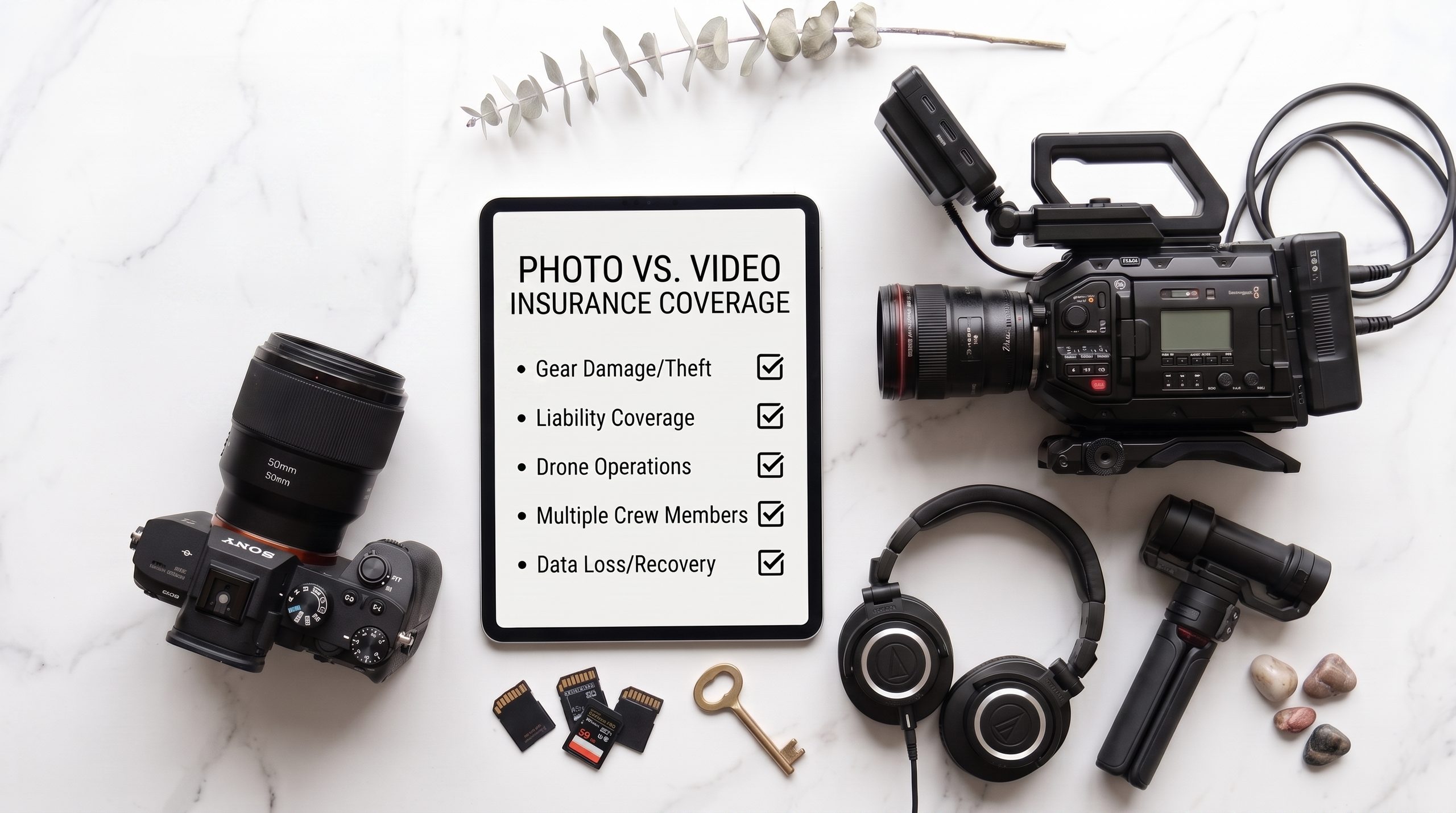
A wedding only happens once, and there’s no reshoot day if something goes wrong. That’s exactly why couples put so much trust in the person behind the camera — and why that person needs the right insurance behind them. Photographers and videographers often get lumped into the same “wedding vendor insurance” category, but the risks they actually carry on the job aren’t identical. Understanding where the coverage overlaps and where it splits can save you from a nasty surprise the one time you actually need to file a claim.
The Baseline Both Need
Before getting into the differences, it’s worth being clear about what photographers and videographers have in common, insurance-wise.
General liability insurance is the non-negotiable starting point for both. It covers bodily injury or property damage you accidentally cause while working — think a guest tripping over a light stand, or a tripod scratching a rented venue’s hardwood floor. Almost every wedding venue will ask for a certificate of insurance before letting a vendor set foot inside, and this is the policy they’re asking about.
Professional liability insurance, also called errors and omissions (E&O) coverage, is the second essential layer for both. It protects you if a client claims your work didn’t meet what was promised — missed shots, a corrupted memory card, or a final product that never arrived. General liability won’t touch this kind of claim; only E&O will.
So far, photographers and videographers are on the same page. The differences start once you look closer at what actually goes wrong on set.
Where the Coverage Starts to Diverge
Different Kinds of E&O Claims
The E&O category is the same on paper, but the claims inside it look different depending on the medium.
Photographers tend to see claims tied to: lost or corrupted image files, missed key moments (the first kiss, the ring exchange), or delivering fewer edited images than the package promised.
Videographers deal with a more layered set of failure points: audio that’s missing or badly out of sync, dropped frames or corrupted video files (which are far larger and more failure-prone than photo files), editing delays that push delivery months past the promised date, or a highlight reel that doesn’t match what was pitched during the sales call. Because video production involves more moving technical parts — external audio recorders, sync software, multiple camera angles — there are simply more points where something can go wrong, and insurers price that into the policy.
Equipment Coverage Looks Different Too
Both professions carry equipment worth protecting, but the makeup of that equipment isn’t the same.
A photographer’s kit is usually built around multiple lenses, several flash units, and one or two camera bodies — a lot of individually valuable pieces. A videographer’s kit tends to concentrate value differently: gimbals and stabilizers, wireless microphone systems, external audio recorders, on-camera monitors, and higher-end editing workstations. When you declare the value of this equipment for a policy, videographers often end up insuring a higher total value in fewer, more specialized items — which can affect the premium and how a claim gets settled if a single piece is damaged or stolen.
Drone Use Changes the Picture
This is where the two paths often split the most. Aerial footage has become a standard part of many wedding videography packages, while it’s used more occasionally by photographers.
Standard general liability and E&O policies typically exclude aircraft-related incidents, and drones legally count as aircraft in most jurisdictions. That means if you fly a drone at a wedding without a dedicated drone liability add-on (or a separate drone policy), an injury or property damage claim involving that drone could fall outside your coverage entirely — leaving you personally exposed. If drone shots are part of your regular offering, this add-on isn’t optional; it’s one of the most important riders to check before your next booking.
The Weight of Post-Production Risk
Video files are large, numerous, and slower to back up — which raises the practical risk of losing footage before it’s delivered. Some videographer-specific policies account for this by explicitly covering data loss or corruption during editing and backup, not just loss on the wedding day itself. Photographers face a lighter version of this same risk, since photo files are smaller and easier to duplicate across multiple storage locations in the field.
Do You Need Two Separate Policies If You Do Both?
Many wedding professionals now offer both photography and videography, either personally or through a small team. In that case, you generally don’t need two completely separate policies — but you do need to make sure your single policy explicitly lists both services and both categories of equipment. A policy written only for “photography services” may not automatically extend to a videography claim, even if you’ve been quietly offering both for years. This is worth a direct conversation with your broker rather than an assumption.
How to Choose the Right Coverage
A few practical questions to bring to any insurance conversation:
- Does the policy name both photography and videography as covered services, or only one?
- Is drone operation included, or does it require a separate rider?
- What’s the total declared value of your equipment, and does it match what you’d actually need to replace it?
- Does the E&O portion cover delivery delays and data loss, not just outright file loss?
- Is coverage per-event, or does it apply as an annual policy across every wedding you shoot that year?
Getting clear answers before booking season starts is far easier than trying to get them after a claim is already in progress.
Final Thoughts
Photography and videography insurance share the same foundation, but the details that matter — E&O claim types, equipment makeup, drone coverage, and data-loss protection — genuinely differ. If you offer both services, don’t assume one policy automatically covers the other; confirm it in writing.
This article is for general informational purposes only and does not constitute insurance, legal, or financial advice. Insurance coverage, requirements, and costs vary by state, country, insurer, and individual business circumstances. Always confirm your specific coverage needs directly with a licensed insurance agent or broker before making a purchasing decision.
Leave a Reply