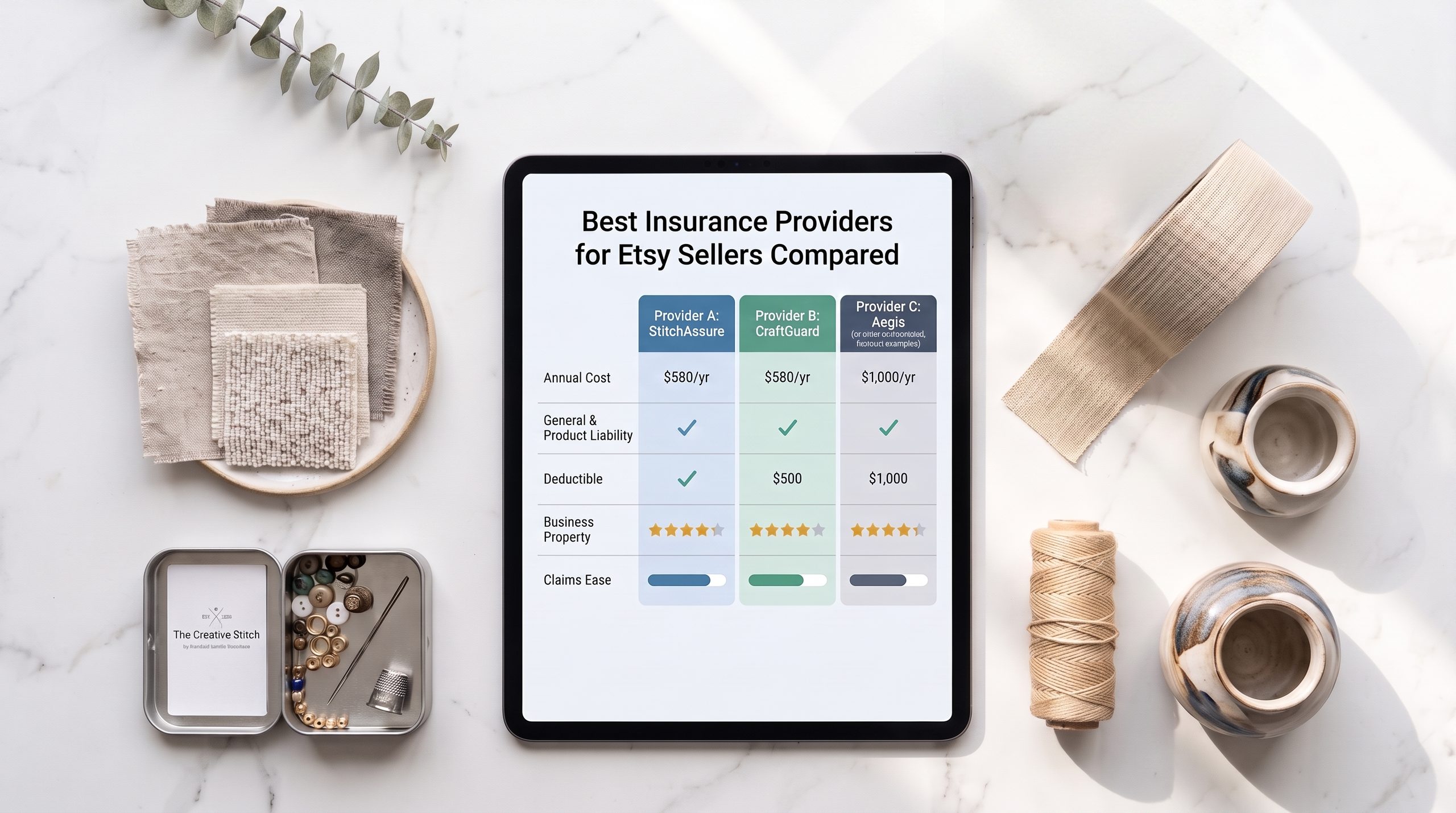
Once you decide you want coverage, the next question is usually “from who?” There isn’t one universal “best” provider — it depends on what you sell, how you sell it, and which country you’re in — but a handful of providers come up repeatedly for handmade and Etsy sellers specifically. This guide compares them so you know where to start.
This article is for general information only and isn’t a substitute for advice from a licensed insurance agent. Pricing, coverage details, and eligibility change over time — always confirm current details directly with a provider before purchasing. We are not affiliated with any provider mentioned here.
How to think about “best” for your specific shop
Before comparing names, it helps to know what actually differentiates providers for a small handmade business:
- Whether they offer both general liability and product liability, or only one
- Whether pricing is monthly/pay-as-you-go or requires an annual lump sum
- How quickly they can issue a Certificate of Insurance if a venue asks for proof of cover
- Whether they specialize in handmade/craft businesses or are a general small business insurer
US-focused providers
Next Insurance (NEXT)
Next Insurance is one of the most visible providers marketing directly to Etsy and online sellers, offering a quote process it advertises as quick, with a printable certificate of insurance available shortly after purchase. It’s part of a broader ecommerce insurance package that, according to one independent review, is structured around tiered plans (Basic, Pro, and Pro Plus) with coverage built specifically for online sellers, and the company has a strong financial strength rating from AM Best despite being a relatively newer insurer. Worth confirming directly which tier includes both general and product liability, since not all plans include the same coverage. Insuranceopedia + 2
Insureon
Insureon operates as a broker/marketplace rather than an insurer itself — it lets sellers compare quotes from multiple providers through a single online application, which can save time if you want to shop around without filling out separate forms for each insurer. A common recommendation for Etsy sellers through Insureon is a Business Owner’s Policy (BOP), which bundles general liability and commercial property coverage together. ACT InsuranceACT Insurance
ACT Insurance
ACT positions itself specifically around arts and crafts businesses, describing itself as built for makers and independent crafters rather than small businesses generally. Its ACT Pro plan includes product liability coverage for claims like injuries, allergic reactions, and property damage caused by what you sell, and according to the company, ACT Pro pricing starts at $24.25 per month — though note that starting prices are typically for the lowest-risk product categories and lowest coverage limits, not necessarily representative of what you’d pay. The Hartford + 2
The Hartford
A larger, more established commercial insurer that also markets Etsy-specific coverage, offering general liability insurance designed to help cover claims of bodily injury or property damage connected to the business. As a larger, more traditional insurer, it may suit sellers who want a well-known, long-established company name over a newer, ecommerce-specific startup, though it’s worth comparing whether the application process is as fast as newer providers built specifically for online sellers. NEXT
UK-focused providers
For UK-based Etsy sellers, the equivalent landscape looks different — providers like Simply Business, Superscript, and PolicyBee are commonly used, offering public liability and product liability cover built around UK regulation rather than US state-based rules. See our [Etsy Seller Insurance UK guide] for details specific to UK sellers.
What general pricing looks like across providers
Based on published industry figures rather than any single provider’s marketing, annual premiums for small Etsy sellers commonly fall in the range of roughly $300 to $1,200 per year, with product liability coverage limits often starting around $100,000. Where you land in that range depends heavily on your product category, revenue, and the coverage limit you choose — treat this as a general shape, not a quote.
Questions worth asking any provider before choosing
- Does this specific plan include both general liability and product liability, or do I need to add product liability separately?
- Can you issue a Certificate of Insurance same-day or within a few days if I need one for a market or fair?
- Is pricing monthly/pay-as-you-go, or does it require a full annual payment upfront?
- Does this policy exclude any product categories I sell (children’s items, cosmetics, food)?
- Is customer support available if I have questions about a claim, and how is that support structured?
How to actually compare quotes
Rather than picking a provider based on brand recognition alone, get quotes from at least two or three of the options above using the same details about your shop (product category, estimated revenue, whether you sell in person). This is the only way to see real differences in price and included coverage for your specific situation, since marketed starting prices rarely reflect what most sellers actually pay.
Frequently asked questions
Is a broker like Insureon better than going directly to an insurer like Next Insurance?
Neither is inherently better — a broker lets you compare multiple insurers in one place, while going direct to a single insurer can sometimes be faster if you already know which coverage you want. It’s reasonable to try both and compare.
Do craft-specific insurers like ACT offer better coverage than general small business insurers?
Not necessarily better, but potentially more tailored — specialist providers may have clearer guidance and pricing for craft-specific risks (like candle-making or jewelry), while general insurers may offer more flexibility if your business spans multiple categories.
Should I choose the cheapest option?
Price matters, but coverage gaps matter more — a cheaper policy that excludes a product category you sell, or caps out at a lower claim limit, isn’t actually a better deal if it doesn’t cover the risk you’re most exposed to. Compare what’s included before comparing price alone.
Can I switch providers later if I’m not happy?
Generally yes, similar to most types of insurance — you can typically switch at renewal, or in some cases cancel and move to a new provider, though it’s worth checking your current policy’s cancellation terms first.
This article is for general informational purposes only and does not constitute insurance, legal, or financial advice. Insurance coverage, requirements, and costs vary by state, country, insurer, and individual business circumstances. Always confirm your specific coverage needs directly with a licensed insurance agent or broker before making a purchasing decision.
Leave a Reply