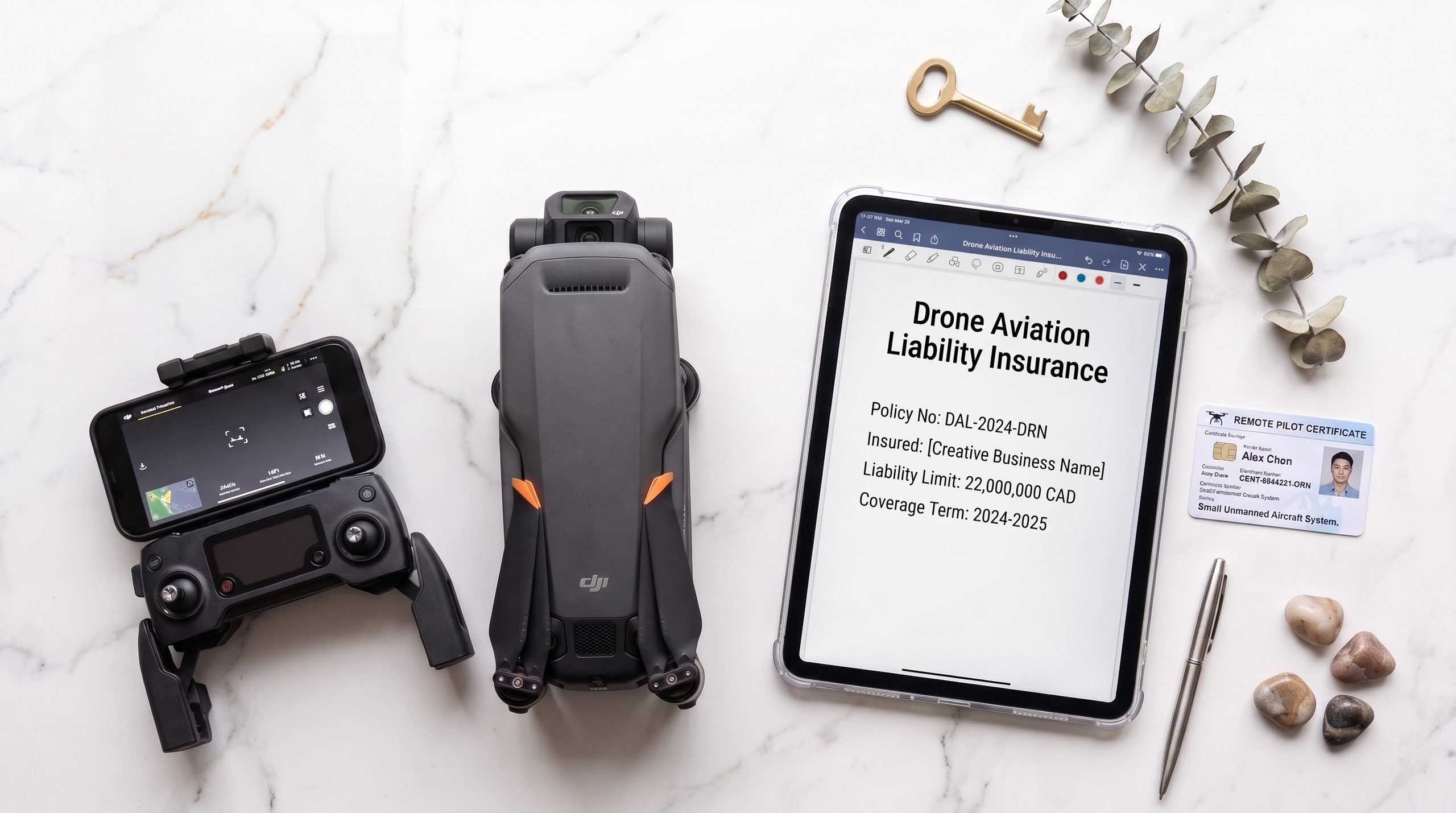
Aerial footage has become a common add-on for wedding videographers, but drones introduce a genuinely different risk category than ground-based camera equipment — aviation regulation, a higher potential severity if something goes wrong, and insurance gaps that catch many videographers by surprise. This guide covers what actually applies if you offer drone footage at weddings.
This article is for general information only and isn’t a substitute for advice from a licensed insurance agent or aviation regulatory guidance. Drone regulations and insurance requirements vary significantly by country — always confirm current rules with your national aviation authority and a provider that specifically covers drone operations.
Why drones are treated differently from ground-based equipment
A dropped camera can damage a table or injure someone nearby. A drone incident has a meaningfully different risk profile — loss of control near guests, a crash into a building or vehicle, interference with other aircraft in restricted airspace, or a fall causing serious injury given the drone’s height and speed at the time of an incident. This is exactly why many standard general liability and equipment policies specifically exclude drone operation rather than treating it as just another piece of gear.
Standard photographer/videographer insurance often doesn’t cover drones
This is the single most important thing to check if you offer aerial footage: many general liability and equipment policies built for ground-based photography and videography explicitly exclude drone operation, or require a specific endorsement or entirely separate policy to include it. Don’t assume your existing wedding videography coverage extends to drone work just because it covers your other equipment — confirm this directly and explicitly with your provider.
Aviation regulatory requirements — separate from insurance
Before insurance even enters the picture, most countries require commercial drone operators to hold specific certification:
- In the US, commercial drone use (which includes any paid wedding videography work) generally requires an FAA Part 107 Remote Pilot Certificate.
- In the UK, commercial drone operation typically requires registration with the Civil Aviation Authority and, depending on drone weight and operation type, specific operational authorizations.
- Other countries have their own aviation authority requirements, and rules can differ significantly by drone weight, operating altitude, and proximity to people or restricted areas.
Operating without required certification isn’t an insurance issue — it’s a legal and regulatory one, and it can also complicate or void insurance coverage if a claim arises from uncertified operation.
What drone-specific liability insurance typically covers
Where standard coverage falls short, dedicated drone liability insurance (sometimes called UAV or UAS insurance) is built specifically around this risk:
- Third-party bodily injury or property damage caused by the drone during operation
- Damage to structures, vehicles, or property caused by a crash or loss of control
- In some policies, coverage tied specifically to your certification status and compliance with aviation regulations
Hull coverage: protecting the drone itself
Separate from liability, “hull coverage” (a term borrowed from aviation insurance generally) protects the drone and its equipment (camera, gimbal, controller) against damage or loss — similar in concept to equipment insurance for ground-based gear, but often priced and structured as its own product given the different risk and higher cost of professional drone equipment.
Does the venue’s insurance requirement account for drones?
Not necessarily, and this is worth clarifying directly: a venue’s general Certificate of Insurance requirement is typically written with ground-based vendor risk in mind. Some venues have separate, specific policies about drone use — including outright bans in some cases — that exist independently of any insurance conversation. Confirm both the venue’s drone policy and their insurance requirements for aerial work specifically, since these are two separate questions.
Restricted airspace and venue-specific considerations
Beyond insurance, practical restrictions matter: proximity to airports, government buildings, or other controlled airspace can make drone operation illegal regardless of insurance or certification. This is worth checking well before a wedding, not discovering on the day, since some venues that seem unremarkable may fall within restricted zones you wouldn’t expect.
What to ask a provider specifically about drone coverage
- Does this policy require proof of my Part 107 (or equivalent) certification to provide coverage?
- Does it cover both liability (third-party harm) and hull coverage (damage to the drone itself)?
- Are there restrictions on where or how I can operate for coverage to apply (altitude limits, distance from people, time of day)?
- Does coverage apply per-flight, per-event, or as an annual policy?
Frequently asked questions
Can I just add drone coverage to my existing wedding videography policy?
Sometimes, if your provider offers a drone endorsement — but not always. Many photographers and videographers end up with a separate, dedicated drone policy rather than an add-on to their standard coverage, since the risk profile is different enough that not all insurers handle it as a simple addition.
Do I need drone insurance if I only fly occasionally, not as a core service?
The regulatory certification requirement (like FAA Part 107 in the US) generally applies regardless of how often you fly commercially, and the insurance gap in standard policies exists whether you fly weekly or a few times a year — occasional use doesn’t reduce the case for having appropriate coverage in place.
What happens if a venue bans drones but I fly anyway without telling them?
Beyond the relationship and reputational risk, this could also affect your insurance coverage if a claim arises from operation the venue explicitly prohibited — worth treating a venue’s drone policy as a hard boundary, not a suggestion.
Does my equipment insurance for cameras and lenses cover my drone too?
Not automatically — as with liability, standard camera/video equipment coverage frequently excludes drones or treats them as a separate category requiring specific hull coverage. Confirm this explicitly rather than assuming your existing equipment policy extends to aerial gear.
This article is for general informational purposes only and does not constitute insurance, legal, or financial advice. Insurance coverage, requirements, and costs vary by state, country, insurer, and individual business circumstances. Always confirm your specific coverage needs directly with a licensed insurance agent or broker before making a purchasing decision.
Leave a Reply