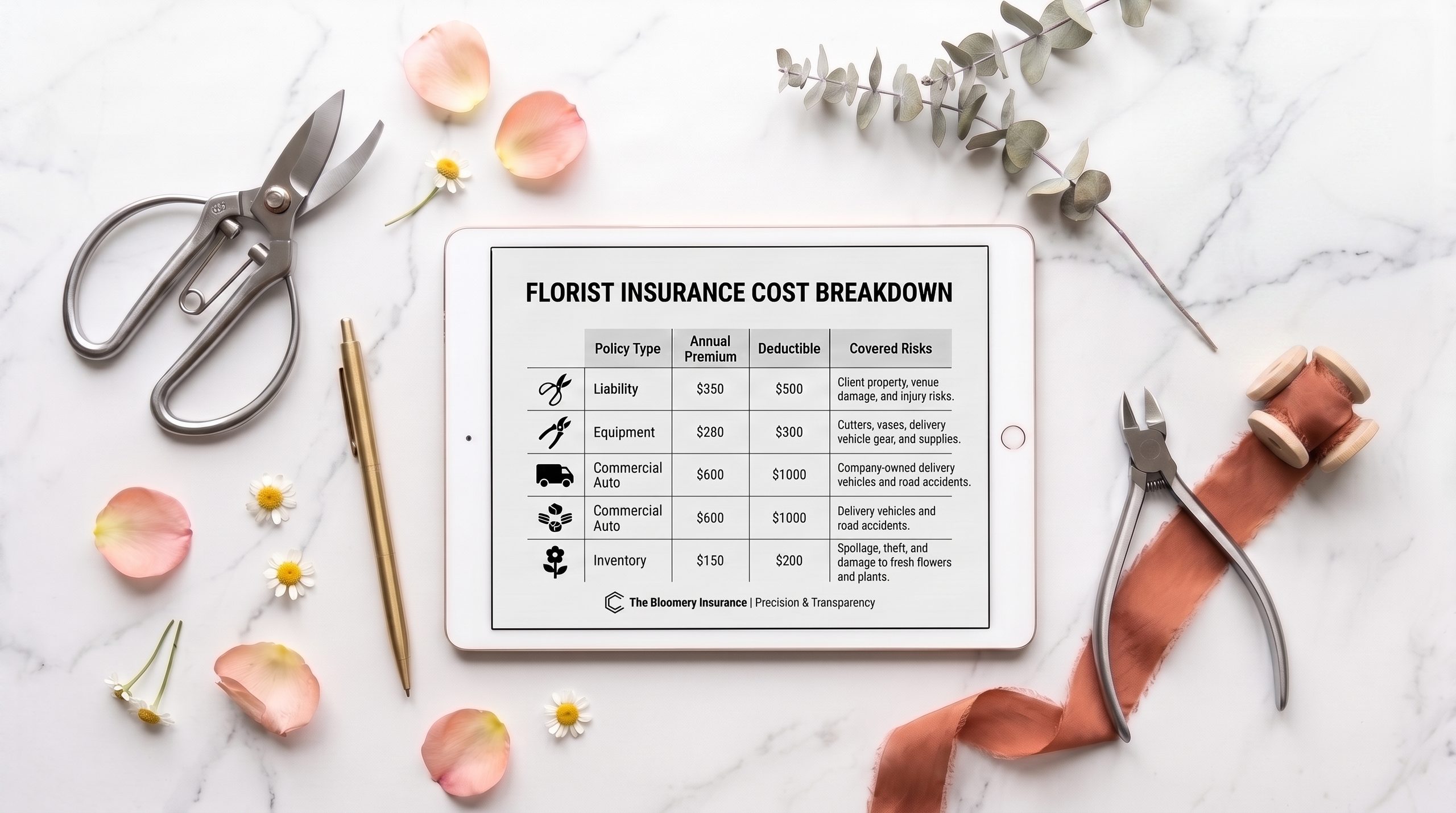
One of the first questions florists ask before buying a policy isn’t “what does it cover?” — it’s “what’s this going to cost me?” The good news: floral businesses tend to fall on the more affordable end of the wedding-vendor insurance spectrum compared to photographers, caterers, or venues. Here’s a realistic breakdown of what to expect, and what actually moves the price up or down.
General Liability Insurance: The Baseline Cost
General liability is the policy almost every venue asks to see before letting you set up, and it’s also the most affordable piece of coverage for most florists. Based on recent industry data, the median annual premium for florists and flower shops sits around $450 per year — noticeably lower than higher-foot-traffic or higher-risk industries like janitorial services or e-commerce, which often land closer to $750-$850 per year for the same type of coverage.
If you’re looking for a higher coverage limit — say, a $1 million policy, which some larger venues specifically require — the annual cost tends to land closer to $800-$900 per year, depending on your location, revenue, and claims history.
What Actually Moves Your Premium Up or Down
Insurers price florist policies based on a handful of factors, and understanding them helps you know whether a quote is reasonable for your situation:
- Revenue and business size. A solo florist doing 15 weddings a year will generally pay less than a studio with several designers and a storefront.
- Physical location and storefront vs. mobile-only. Florists operating out of a retail space with regular foot traffic typically pay more than those working from a home studio or warehouse with no walk-in customers.
- Scope of installations. Regularly building large structures — arches, hanging installations, ceiling florals — that require ladders or scaffolding tends to push premiums higher than simple bouquet and centerpiece work.
- Claims history. A clean claims record over the past few years is one of the biggest levers for getting a lower renewal rate.
- Coverage limit. Moving from a standard $1 million/$2 million aggregate policy to higher limits increases the premium, though usually not dramatically for a small operation.
Bundling: The Business Owner’s Policy (BOP) Option
Rather than buying general liability and property insurance separately, many florists save money by bundling them into a Business Owner’s Policy (BOP). A BOP typically combines general liability with coverage for your studio, tools, coolers, and inventory in a single, discounted package — often costing less than the sum of the two policies bought individually. If you lease a storefront or workshop space, this is usually the more cost-effective starting point.
Other Coverage That Adds to the Total
General liability is the foundation, but a full insurance picture for a working wedding florist often includes:
- Professional liability (E&O): Usually a modest additional cost, covering claims that your delivered work didn’t match what was promised.
- Commercial auto or a business-use rider: Adds to the total if you regularly transport arrangements in a vehicle not already covered for business use.
- Workers’ compensation: Required in most states once you have employees, even seasonal wedding-day help — cost scales with payroll size.
Adding these on top of general liability, a small-to-mid-size floral business focused on weddings might realistically expect to pay somewhere in the range of a few hundred to just over a thousand dollars per year in total coverage, depending on how many of these layers apply.
How to Get the Best Rate
- Compare at least three quotes. Premiums for the same coverage can vary meaningfully between insurers for a small business.
- Ask about bundling general liability with property or professional liability before buying them as separate policies.
- Increase your deductible if you have some cash flexibility — a higher deductible often lowers the annual premium noticeably.
- Review your coverage yearly as your business grows; a policy sized for your first year of business may be outdated once you’re doing triple the weddings.
Final Thoughts
Wedding florist insurance is one of the more budget-friendly pieces of vendor coverage in the wedding industry, with general liability policies often starting in the low hundreds of dollars per year. The real cost swings come from your business size, whether you operate a storefront, the scale of your installations, and how many additional coverage types — professional liability, commercial auto, workers’ comp — apply to your operation.
This article is for general informational purposes only and does not constitute insurance, legal, or financial advice. Insurance coverage, requirements, and costs vary by state, country, insurer, and individual business circumstances. Always confirm your specific coverage needs directly with a licensed insurance agent or broker before making a purchasing decision.
Leave a Reply