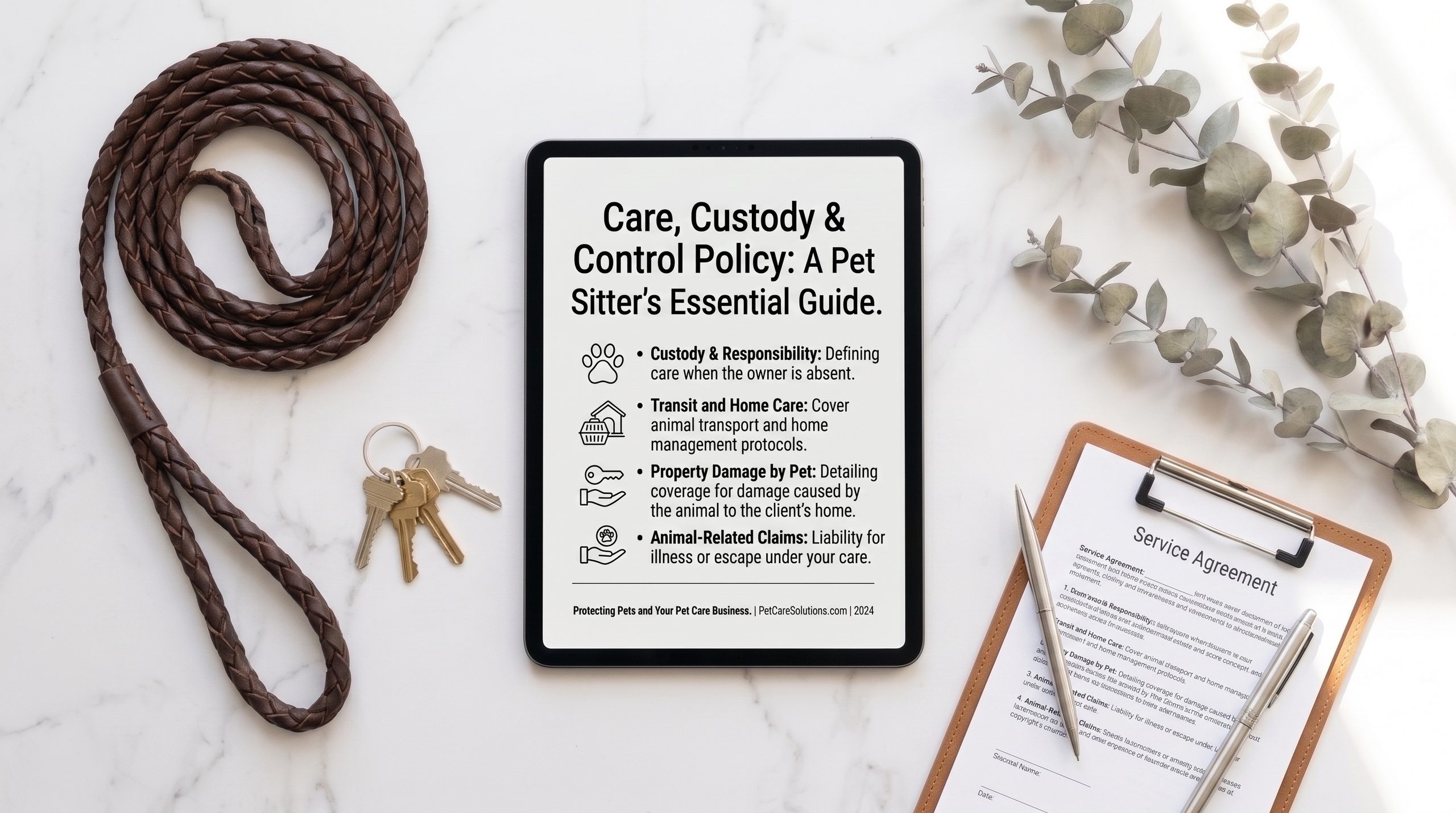
Here’s a detail that catches a lot of new pet sitters off guard: a standard general liability policy, the one every business is told to start with, almost certainly does not cover the pets you’re actually being paid to look after. This isn’t a rare exclusion buried in fine print — it’s a standard, near-universal clause in commercial general liability policies, and understanding it is the single most important thing a pet sitter can know about their insurance.
The Exclusion That Catches Everyone Off Guard
Nearly every general liability policy contains what’s known as the care, custody, or control (CCC) exclusion. It excludes coverage for personal property that’s physically in your care, custody, or control at the time of a loss. For most businesses, this exclusion is a non-issue — a bookkeeper or a consultant rarely handles a client’s physical belongings in a way that would trigger it.
For a pet sitter, it’s the opposite. Under the law, pets are considered personal property — which means the exclusion applies directly to the one thing your entire business revolves around. Without an additional endorsement, a standard general liability policy would provide no coverage at all if a pet in your care were injured, became ill, or died while under your supervision.
What CCC Coverage Actually Adds Back
Care, custody, and control coverage is a specific endorsement that reverses this exclusion for pet-related businesses. It typically covers:
- Veterinary medical expenses for a pet injured, poisoned, or made ill while in your care — and importantly, this usually pays out regardless of fault or negligence, unlike standard liability claims that require proving you caused the harm.
- The client’s personal property that was in your care alongside the pet, up to a specified limit — though it’s worth checking your policy specifically, since some insurers cover only the pet and offer client property protection as a separate, more limited add-on.
- Pets in transit, if you transport animals in a vehicle or pet taxi as part of your service.
Real Claims That Show Why This Matters
Industry claims data makes the case better than any hypothetical could. A few recurring patterns:
- Medication mix-ups. A sitter caring for two cats — one diabetic, one not — accidentally gave insulin to the wrong cat and failed to medicate the one who needed it. Both required emergency veterinary treatment.
- Dogs escaping and being struck by vehicles, with veterinary costs from these incidents commonly running into the thousands.
- Ingestion incidents during walks — dogs swallowing acorns, rocks, toys, or other foreign objects that require emergency treatment.
- Property damage unrelated to the pet directly — a classic example is a sitter accidentally letting a toilet overflow, causing extensive water damage to a client’s home.
These aren’t rare edge cases. Industry data consistently shows that care, custody, or control claims are the single most frequent type of claim pet sitters file — which is exactly why this coverage isn’t an optional extra so much as the core of what a pet-specific policy actually needs to include.
Choosing the Right Coverage Limit
CCC coverage typically comes with a selectable limit, commonly ranging from $10,000 to $200,000 per occurrence. This is worth taking seriously rather than defaulting to the cheapest option:
- A $10,000 limit is common, but often inadequate. Emergency veterinary care for a severe injury can exceed this quickly, especially for conditions requiring surgery, hospitalization, or ongoing treatment.
- Industry sources note that a large share of sitters under-select their limit — choosing the minimum available rather than sizing coverage to their actual exposure, such as the number and value of pets they typically care for.
- Consider the animals you actually work with. A sitter regularly caring for larger dogs, multiple pets per visit, or higher-value breeds carries meaningfully more exposure than one doing occasional cat check-ins, and the limit chosen should reflect that.
What to Confirm Before You’re Relying on It
- Ask explicitly whether CCC coverage is included, or a separate add-on. Many general “pet sitter insurance” products vary significantly in whether this is bundled by default.
- Check whether the coverage pays regardless of fault. Some policies limit payouts to cases where clear negligence can be shown — a much harder bar to clear, and one that leaves genuine accidents uncovered.
- Confirm whether independent contractors are covered, not just employees — some insurers only extend CCC coverage to direct employees, leaving contracted sitters exposed.
- Check whether transport and overnight boarding are included, if either is part of your service — these sometimes require a separate endorsement beyond standard CCC coverage.
This article is for general informational purposes only and does not constitute insurance, legal, or financial advice. Insurance coverage, requirements, and costs vary by state, country, insurer, and individual business circumstances. Always confirm your specific coverage needs directly with a licensed insurance agent or broker before making a purchasing decision.
Leave a Reply