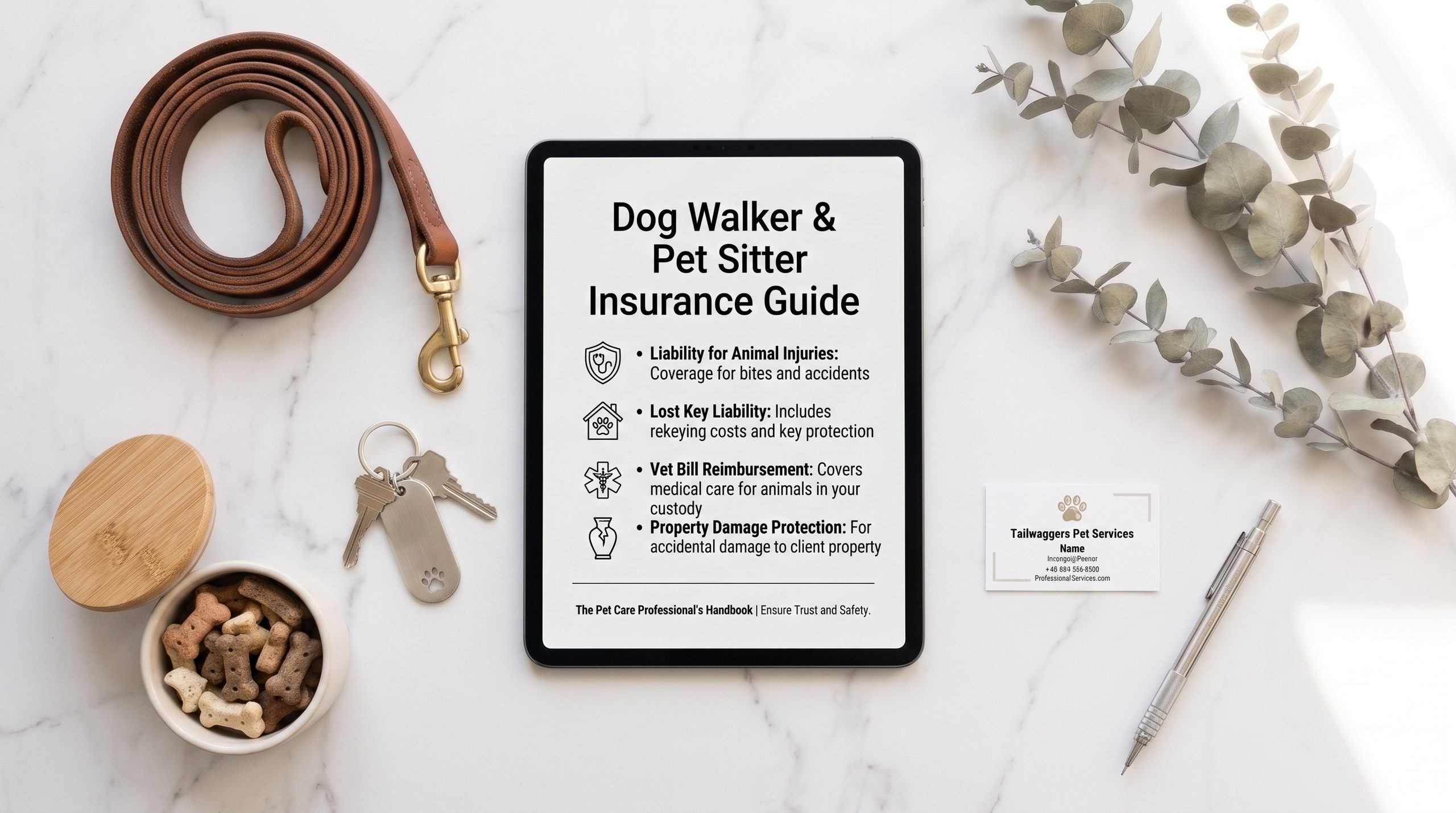
Spending your day with other people’s pets sounds low-risk compared to running heavy equipment or working on a construction site — until you consider that you’re regularly alone in someone’s home, handling their pet’s safety, and often holding their house key. Here’s what actually needs covering, and the terms clients will expect you to know.
The Core Coverage: General Liability
General liability insurance is the foundation for any pet sitter or dog walker, covering third-party claims for bodily injury or property damage connected to your work — a client injured when a dog you’re walking pulls free and knocks them over, or damage to a client’s home during a visit.
But standard general liability has an important blind spot for this industry specifically: it typically excludes property in your care, custody, or control — which, for a pet sitter, is exactly what a pet itself is.
Care, Custody, and Control (CCC) Coverage
This is the coverage that actually protects the animals you’re looking after, and it’s arguably the most important add-on in this entire industry. Standard general liability policies cover bodily injury to others and damage to a home’s structure, but they generally don’t cover injury to a pet that’s directly in your care — the exact scenario a pet sitter faces every single day.
CCC coverage (sometimes marketed as “animal bailee” coverage) closes that gap, covering veterinary costs or losses if a pet in your care is injured, becomes ill, or goes missing while under your supervision. Given that the entire service you’re offering revolves around being trusted with someone else’s pet, this isn’t really an optional extra — it’s close to the core of what “pet sitter insurance” actually means in practice.
Where the Real Claims Come From
Understanding common claim patterns helps explain why certain coverage matters more than it might seem:
- Dog bites during walks are among the costliest claims in the industry. A frequent pattern: a sitter is walking a dog when it reacts to another dog or person nearby, leading to a bite injury — sometimes to the third party, sometimes to another animal.
- Property damage inside a client’s home — a knocked-over lamp, a scratched door, water damage from an overflowing pet bowl.
- Lost keys, which can trigger the cost of rekeying an entire home, not just replacing a key.
- Theft or dishonesty, particularly relevant if you employ other sitters or walkers who work unsupervised inside clients’ homes.
Bonding: What It Is (and Isn’t)
You’ll frequently see pet care businesses advertise as “insured and bonded,” and it’s worth understanding that a bond is not insurance. A bond is a guarantee to your clients that if you or an employee steals from them, they’ll be compensated — the bond company pays the client first, then seeks reimbursement from whoever was responsible.
Bonding isn’t legally required in most places, but it carries real weight with clients, since many pet owners specifically look for “bonded” sitters as a trust signal before handing over a house key. A standard bond (often around a $10,000 limit) typically costs in a modest annual range, making it a low-cost way to add credibility, even where it’s not required.
Employee dishonesty coverage serves a similar purpose to bonding but is arranged directly through your insurer rather than a separate bonding company — worth asking your insurer whether they offer it as an alternative or complement to a standalone bond.
Workers’ Compensation
If you employ other sitters or walkers, workers’ compensation is required in most states the moment you have any employee, covering medical costs and lost wages if a team member is injured on the job — including injuries from dog bites or falls during a walk.
Do Apps Like Rover or Wag Cover You?
No. Most pet care platforms and marketplace apps do not provide insurance coverage for the sitters and walkers who use them, regardless of how “professional” the platform positions itself. If you work through one of these apps, the responsibility for carrying your own insurance sits entirely with you.
What to Look for in a Policy
- General liability with a meaningful limit — commonly at least $1 million, though check what specific clients or employers might expect.
- Care, custody, and control coverage explicitly included, not assumed — confirm this directly rather than taking “pet sitter insurance” at face value, since coverage details vary between providers.
- Coverage that follows you across settings — a client’s home, in transit, at your own home if you offer boarding — since pet care work rarely happens in one fixed location.
- Bonding or employee dishonesty coverage, particularly if key access or in-home visits are part of your service.
- Workers’ compensation, if you have any employees or independent contractors working under your business.
This article is for general informational purposes only and does not constitute insurance, legal, or financial advice. Insurance coverage, requirements, and costs vary by state, country, insurer, and individual business circumstances. Always confirm your specific coverage needs directly with a licensed insurance agent or broker before making a purchasing decision.
Leave a Reply